
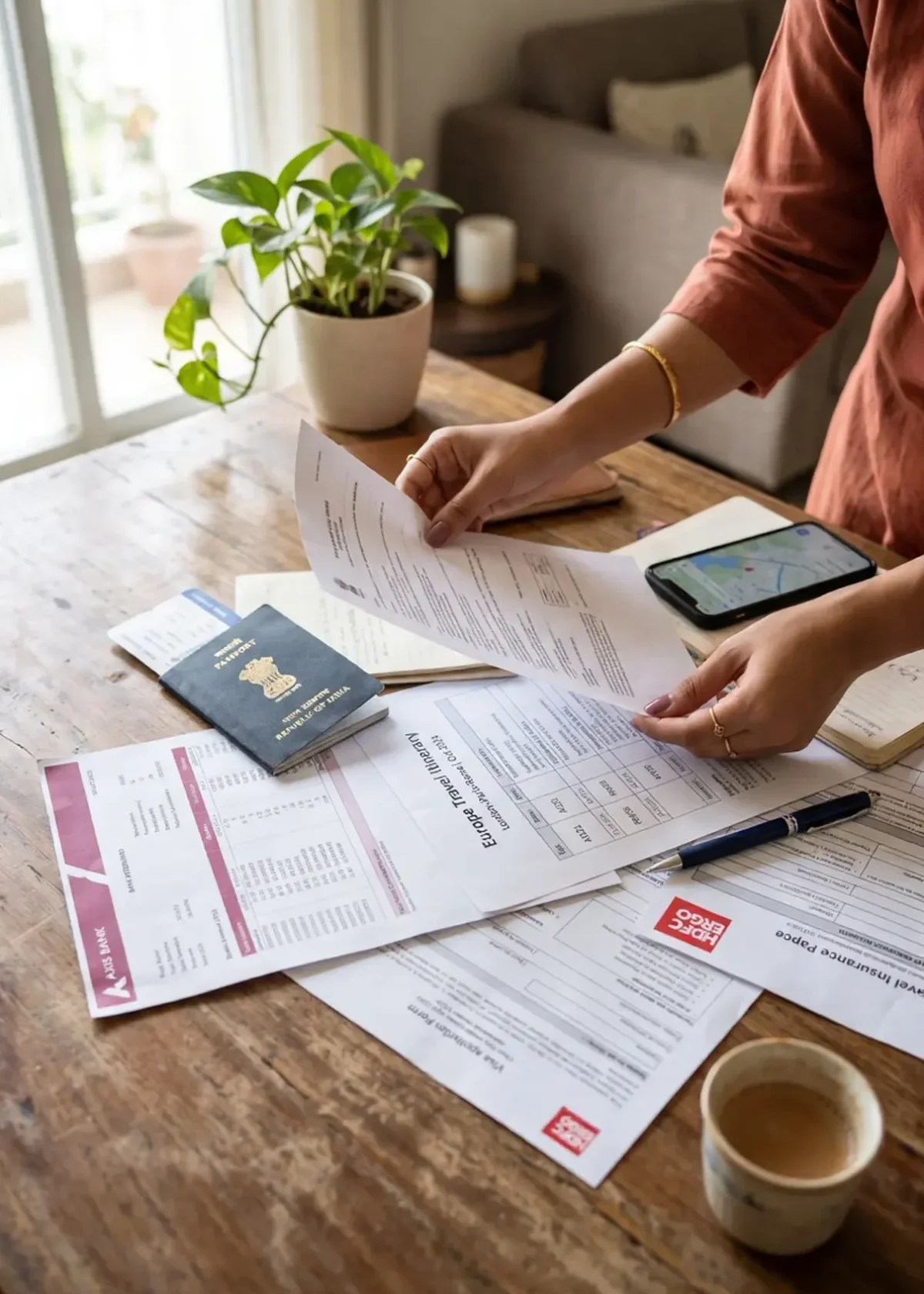
Most first-time applicants treat their Schengen visa like an exam: collect every document on the checklist, get each one signed correctly, submit, and wait. It feels thorough, and for a lot of applications, it is enough.
But a visa officer isn’t grading a checklist. They’re reading a file and asking a simpler question: does this story add up? An applicant can have every document technically present and still leave the consulate with doubts, because the itinerary doesn’t match the budget, or the cover letter says one thing while the hotel bookings suggest another. Most Schengen visa rejection reasons trace back to exactly this, not a missing form, but a file that doesn’t read as consistent.
That matters more for Indian applicants than most checklist articles let on. Joint family finances, self-employment, or a first international trip don’t always fit neatly into a template built for a salaried applicant with years of travel history. None of that is a problem by itself. It just means the application needs to explain itself a little more carefully.
Why an otherwise complete application can still raise concerns
Refusals are governed by Article 32 of the EU Visa Code, and the grounds are broader than most people expect: unclear travel purpose, insufficient proof of funds, doubts about intention to return, unreliable or contradictory documentation. Refusal rates across recent application cycles have generally sat somewhere in the mid-teens percentage range, and the reasons behind them rarely come down to one missing paper. They’re usually a pattern.
Here are five mistakes that should be taken seriously, along with what a better version of each looks like.
Mistake 1: Financial proof that doesn’t convincingly support the trip
A bank statement showing a good balance might seem reassuring, but visa officers are looking at whether it makes sense according to the applicant’s income pattern, not just whether the numbers are big. A sudden large deposit two weeks before applying, or income that doesn’t match the stated job, raises suspicion, even if the closing balance looks fine on paper. Self-employed applicants and business owners often run into this issue, because their income can look irregular, even if it’s completely legitimate.
It also helps to understand how much a Europe trip actually costs for an Indian couple so the planned expenses and available funds are realistic.
A solid approach relies on being consistent over time rather than just having a good balance right before applying. A few months of steady, sensible financial activity helps more than making a big transfer. If a relative or spouse is sponsoring the trip, the sponsorship letter and supporting documents strengthen the story instead of just leaving a hint of the relationship.

Mistake 2: An itinerary that doesn’t practically add up
A common pattern in a weak application is an itinerary that feels more like a wishlist than a plan: four countries in seven days, cities that are hours apart with no realistic way to get between them, or stating ‘tourism’ as the purpose while keeping a schedule that leaves almost no time to actually see anything.
It’s not really about being too literal. A travel plan that might not actually be possible suggests that the itinerary was made to satisfy the application, not to reflect someone’s actual travel intentions. The cities should be grouped based on proximity, and there should be enough days in each so that the purpose makes sense. If the trip revolves around a wedding, a conference, or a family visit, the itinerary should clearly be structured around that central point, not just a line of unrelated stops. A simple test: can you explain your day-to-day plan out loud in order without looking at notes? If it’s hard to tell naturally, a consular officer will find it just as hard to understand.
Mistake 3: Documentation that’s inconsistent, not just incomplete
Missing documents can usually be fixed, either before submission or through a follow-up request. Inconsistency is a different thing: it happens when the existing documents don’t completely match each other, like an employer letter that’s months old, a hotel booking with a different date than the cover letter, or a return flight that doesn’t match the stated length of stay. Often, it’s not because the applicant directly lied. It happens because the application was prepared in pieces, over multiple sessions, without a final check to make sure everything aligns. Look at the entire application as a single document rather than separate folders of documents, and make sure the dates, names, addresses, and travel duration exactly match in the form, cover letter, flight booking, and hotel confirmation.
This is also where the Schengen visa documents required from India come into play, and there is no single universal list. Requirements shift by destination country and by circumstance, but broadly include a completed form, a valid passport, photographs in the specified format, travel insurance, proof of accommodation, a travel itinerary, and financial and employment or business documentation. Always check the official checklist for your specific consulate rather than a generic list found online.
Mistake 4: A cover letter that doesn’t actually explain anything
Cover letters are usually of two kinds: either they are skipped, reduced to a few generic lines, or turned into a long, personal story to convince the officer of the applicant’s honesty. Neither really helps much. A cover letter isn’t meant to convince anyone. What a consular officer wants is just a document that clearly states who is traveling, why, when, where, and how it ties in with the supporting documents.
A few genuinely useful Schengen visa cover letter tips: keep it under a page, state the purpose, dates, and route in plain terms, and briefly clarify anything that might look unusual, a recent job change, a short-notice trip, an unconventional itinerary, rather than hoping no one notices. It should support the documents already in the file, not repeat them or add claims nothing else backs up.
Mistake 5: Weak or unclear ties to returning home
This usually comes up for first-time applicants, self-employed individuals, and people between jobs. It’s not about proving loyalty to India. It’s about giving the visa office a logical reason to believe that the applicant has a life to return to: a job, an ongoing business, family responsibilities, or some educational commitment.
Applicants sometimes think that just a strong bank balance is the answer. That’s not true, it’s not enough on its own. A comfortable financial situation and a clear reason to return are two different things that need to be made clear in the file. A strong version could include an employment letter mentioning leave approval and tenure, business registration documents for self-employment, or a note about an ongoing course or family responsibility, which should be clear and current, so that anyone who just reads your employment or business documents can understand that you have a reason to return to India by a specific date.
The appointment in India
Appointments for a Schengen visa application from India go through the relevant application centre, typically VFS Global. Availability varies by city and season, so booking a Schengen visa appointment India slot well ahead of time matters more than people expect, especially in summer and the year-end travel months.
At the appointment itself, carry documents in the order the checklist specifies, bring originals and copies where required, and answer basic questions consistently with what’s written in your application. Not every applicant is interviewed, but being familiar with your own itinerary comes across better than memorising a script.
Processing time, realistically
Schengen visa processing time is one of the more misunderstood parts of the process. Under the EU Visa Code, the standard timeframe is 15 calendar days from when the application is accepted, extendable to 45 days for additional checks. Timelines vary by consulate and season in practice, often within the standard window off-season, considerably longer during peak summer travel.
Apply well ahead of your travel dates and avoid locking in non-refundable bookings that assume approval before your visa is actually in hand. Check current guidance on your consulate’s website closer to your application date, since figures shift from year to year.
Pre-submission checklist
Before you submit, go through the file once more with a critical eye, ideally a day or two after you think it’s finished, not the same evening.
- Do all dates match across the form, cover letter, flight bookings, and hotel confirmations?
- Does the financial documentation show a consistent pattern, not just a healthy number right before applying?
- Can you explain the itinerary out loud without checking notes?
- Does the cover letter state purpose, dates, and route clearly, without repeating documents or adding unsupported claims?
- Do your employment or business documents show a clear reason to return by a specific date?
- Have you checked the official checklist for your specific consulate rather than a generic one?
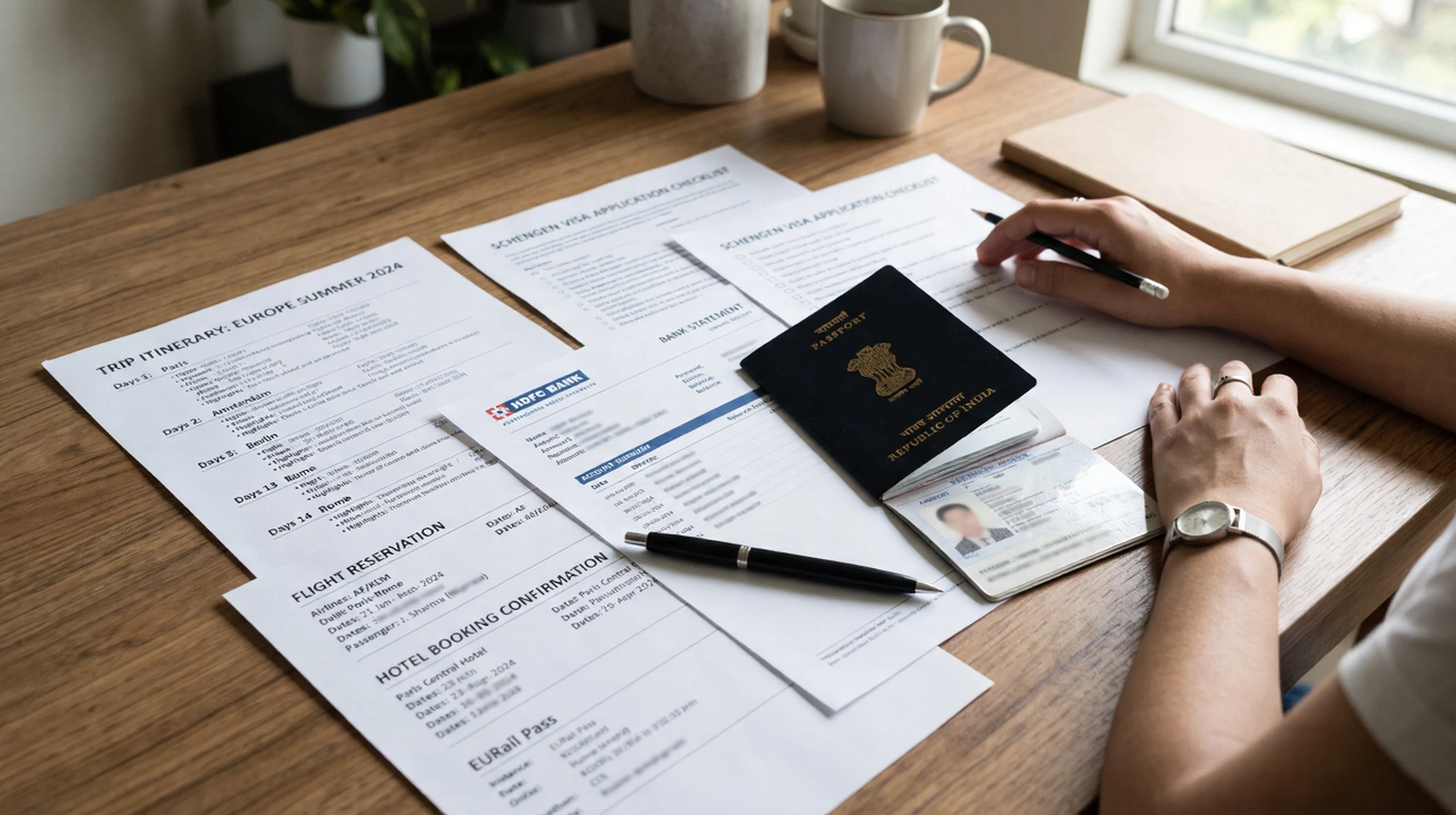
Getting a Schengen visa correctly doesn’t just mean gathering the folder with the biggest stack of documents. It means making sure that every part of that folder tells the same story clearly and consistently. Most Schengen visa rejection reasons come down to a gap somewhere in that story, not a single dramatic error, so a careful final read-through can genuinely change the outcome, though the final decision always rests with the consulate.
Planning an international holiday and need some help getting there? Contact Naviora Journeys for expert assistance and customised holiday packages built around your trip.
Frequently asked questions
What are the most common Schengen visa rejection reasons? Insufficient or inconsistent financial proof, an itinerary that doesn’t practically hold together, contradictory documentation, and unclear ties to the applicant’s home country. Most refusals come down to a pattern across these areas rather than one isolated mistake.
What documents are required for a Schengen visa from India? It depends on your destination country and individual circumstances, but generally includes a valid passport, a completed form, photographs, financial proof, employment or business documents, accommodation and travel bookings, and travel insurance. Confirm the exact list with your specific consulate.
How long does Schengen visa processing take? The standard timeframe is 15 calendar days once your application is complete, though it can extend to 45 days in some cases. Appointment wait times are separate and can add several more weeks, so apply well before your travel date.
What should I include in a Schengen visa cover letter? A clear statement of who’s travelling, the purpose, the dates, and the route, along with a brief clarification of anything unusual in your circumstances. It should support your other documents rather than repeat or contradict them.
What should I do if my Schengen visa is refused? The refusal letter states the specific grounds. Addressing that particular issue, whether it’s documentation, financial proof, or itinerary clarity, before reapplying is far more useful than resubmitting the same file unchanged.