

In this guide 11 sections
- Andaman weather at a glance: what the numbers say
- Andaman month by month
- Ferries to Havelock and Neil: the part that makes or breaks your trip
- Snorkelling and scuba diving: when the water is at its best
- Honeymoon or family holiday: picking your month
- A sample 5-day Andaman plan (dry season)
- How many days do you need in Andaman?
- What to pack for each season
- Rules and practical details to know before you go
- Mistakes we see travellers make
- Frequently asked questions
Short answer: The best time to visit the Andaman Islands is December to April, when Port Blair (now Sri Vijaya Puram) gets only about 15 to 110 mm of rain a month, the sea is usually calm and ferries to Havelock and Neil run most reliably. November is a good shoulder month with some showers. May to September is the southwest monsoon, with 400 to 500 mm of rain a month and a real risk of ferries being cancelled, and October is still wet.
Most couples and families we speak to pick Andaman because it is the closest thing to a tropical island holiday without a passport. The catch is that the whole trip depends on the sea. Your flight lands in Sri Vijaya Puram, but the beaches you came for, Radhanagar on Havelock and the quiet coves of Neil, are a ferry ride away. When the weather turns, ferries stop, snorkelling trips are called off and a carefully planned five days can shrink to three.
So “best time” here is not only about sunshine. It is about how likely your ferries are to sail, how busy the islands are that week, and how clear the water is for snorkelling.
Andaman weather at a glance: what the numbers say
The figures below are long-term averages for 1991 to 2020 from the Port Blair weather station (WMO station 43333), published in the WMO climate normals archived by NOAA. We have rounded them. Any single year can be wetter or drier, but the pattern is very consistent.
Temperature barely changes: highs sit between about 29°C and 33°C all year and nights stay around 23°C to 25°C. Rain is what matters. The islands get roughly 3,100 mm a year, almost 2,300 mm of it between May and September, and the switch is sudden: April averages about 80 mm, May about 400 mm.
That jump lines up with the monsoon. According to the India Meteorological Department’s normal dates, reported by Down To Earth, the southwest monsoon usually reaches the south Andaman Sea around 15 May and covers the Andaman and Nicobar Islands around 20 May, well before it reaches Kerala.
| Month | Avg high / low | Avg rain | Rainy days | Sea and ferries | Crowds and prices | Our verdict |
|---|---|---|---|---|---|---|
| January | 30°C / 23°C | ~50 mm | ~2 | Usually calm, reliable | Busy first week, then steady | Excellent |
| February | 31°C / 23°C | ~15 mm | ~1 | Calmest, most reliable | Moderate | Excellent |
| March | 32°C / 23°C | ~35 mm | ~2 | Calm, reliable | Moderate, Holi weekend busier | Excellent |
| April | 33°C / 25°C | ~80 mm | ~4 | Mostly calm, warmer | Rising with school holidays | Very good |
| May | 32°C / 25°C | ~400 mm | ~16 | Changeable after mid-May | Family peak early, then drops | Early May only |
| June | 30°C / 25°C | ~480 mm | ~19 | Rough spells, cancellations | Quiet, lower rates | Not for first-timers |
| July | 30°C / 24°C | ~450 mm | ~19 | Rough spells, cancellations | Quiet | Avoid for beach holidays |
| August | 30°C / 24°C | ~460 mm | ~19 | Rough spells, cancellations | Quiet, Independence Day weekend busier | Avoid for beach holidays |
| September | 30°C / 24°C | ~500 mm | ~20 | Wettest month | Quietest | Avoid |
| October | 30°C / 24°C | ~300 mm | ~15 | Improving but unsettled | Busy around Durga Puja and Diwali | Late October at a push |
| November | 31°C / 24°C | ~220 mm | ~10 | Mostly fine, some rough days | Busy around Diwali, else moderate | Good shoulder month |
| December | 30°C / 24°C | ~110 mm | ~5 | Settling, reliable by mid-month | Peak from Christmas | Very good, book early |
“Rainy days” is the long-term average number of days in the month with measurable rain. Crowd and price notes are our own planning observations, not official statistics.
Andaman month by month
January
Weather: Highs around 30°C, lows around 23°C, about 50 mm of rain over roughly two days. Mornings feel fresh by island standards.
Sea and ferries: Usually calm, and ferries between Sri Vijaya Puram, Havelock and Neil run reliably. A rare winter low-pressure system can still bring a rough day, so we never plan the last ferry on the same day as a flight.
Crowds and prices: The first few days carry over the New Year rush. After the second week it settles into steady, comfortable demand.
Who it suits: Honeymooners who married in the November to February wedding season, and anyone who wants the most dependable weather.
February
Weather: The driest month, with only about 15 mm of rain on average and around one rainy day. Highs about 31°C.
Sea and ferries: This is as reliable as Andaman gets. Calm water makes the boat to Elephant Beach comfortable even for people who get seasick.
Crowds and prices: Moderate. Popular Havelock resorts still fill up, especially around Valentine’s week, so book a few months ahead.
Who it suits: Couples, first-time snorkellers and parents travelling with older relatives who want no surprises.
March
Weather: About 32°C by day, around 35 mm of rain over two days. The sun is stronger now, so midday beach time needs shade.
Sea and ferries: Calm and reliable, with good conditions for snorkelling and diving.
Crowds and prices: Moderate, with a short spike around the Holi long weekend when it falls in March.
Who it suits: Couples who want good weather at slightly lower demand than December and January, and divers.
April
Weather: The hottest month, around 33°C by day and 25°C at night, with about 80 mm of rain over four days, often as short afternoon showers.
Sea and ferries: Mostly calm. Ferries run well through the month.
Crowds and prices: Demand climbs again in the second half as school holidays begin in many states.
Who it suits: Families who can travel in the first half of the school break, and couples who do not mind the heat and plan beach time for early morning and late afternoon.
May
Weather: A month of two halves. On average May gets about 400 mm of rain over 16 days, but most of it falls after the monsoon arrives around 15 to 20 May.
Sea and ferries: The first ten days are often fine. After that the sea becomes unpredictable. On 15 May 2026 the Directorate of Shipping Services warned that bad weather could suspend or cancel ship and ferry services at very short notice, as reported by Nicobar Times. Snorkelling and water sports can also be called off on rough days.
Crowds and prices: The first half is busy with summer-holiday families. Once the rain sets in, demand falls quickly.
Who it suits: School-holiday families, but only in the first week or so, with a buffer day.
June
Weather: Full monsoon. About 480 mm of rain over roughly 19 days. It does not rain all day every day, but heavy bursts and grey skies are normal.
Sea and ferries: This is when cancellations become a regular part of planning. A rough spell can keep boats in harbour for a day or more.
Crowds and prices: Quiet, and hotels are more flexible on rates.
Who it suits: Repeat visitors who love the green, moody side of the islands and have flexible plans. Not for a honeymoon or a first visit.
July
Weather: About 450 mm over 19 days. Warm, wet and humid.
Sea and ferries: Similar to June. Expect some cancelled sailings and limited water activities.
Crowds and prices: Quiet.
Who it suits: Very few people. July holidays are better spent elsewhere (see the family section below).
August
Weather: About 460 mm over 19 days.
Sea and ferries: Still monsoon conditions with a real risk of disruption.
Crowds and prices: Quiet overall, with a small bump around the Independence Day long weekend.
Who it suits: Travellers who mainly want to see Sri Vijaya Puram’s history, such as the Cellular Jail, and are relaxed about the beaches.
September
Weather: The wettest month on average, around 500 mm over about 20 days.
Sea and ferries: The least dependable month for inter-island travel.
Crowds and prices: The quietest time of year.
Who it suits: We do not recommend September for a beach holiday.
October
Weather: Rain eases to about 300 mm over 15 days, but October is still a wet month and can bring cyclonic weather in the Bay of Bengal.
Sea and ferries: Improving, but unsettled. Plan with a buffer day.
Crowds and prices: The Durga Puja and Diwali breaks (which fall in October or November, depending on the year) bring a rush, especially from Kolkata and Bengaluru.
Who it suits: Families tied to the festival break who accept some rain. The last week of October is better than the first.
November
Weather: About 220 mm over 10 days, usually as showers rather than all-day rain, and it gets drier as the month goes on.
Sea and ferries: Mostly fine, with the odd rough day.
Crowds and prices: Busy around Diwali if it falls in November, otherwise moderate, and often better value than December.
Who it suits: Couples marrying early in the wedding season and anyone who wants green islands and easier bookings, with a small rain risk. Late November is our favourite shoulder slot.
December
Weather: About 110 mm over five days. Early December can still bring the tail end of the northeast monsoon showers, and by mid-December the dry season has usually settled in.
Sea and ferries: Reliable by the second half of the month.
Crowds and prices: From about 20 December to 2 January, this is the busiest and most expensive stretch of the year. Ferry seats and the best rooms on Havelock go first.
Who it suits: Everyone, as long as you book early. If you can travel in the first half of December, you get almost the same weather with far less pressure on bookings.
Ferries to Havelock and Neil: the part that makes or breaks your trip
There are no road links between the islands. To reach Havelock (now Swaraj Dweep) and Neil (now Shaheed Dweep), you take a ferry from Sri Vijaya Puram. There are two kinds: government ships run by the Directorate of Shipping Services, and private catamarans, which are faster and more comfortable. Havelock and Neil are also linked to each other directly, so a typical route is Sri Vijaya Puram to Havelock, Havelock to Neil, and Neil back to Sri Vijaya Puram.
How likely is a cancellation?
From December to April, cancellations are uncommon. From mid-May to September, they are a normal part of island life. Services can be suspended at very short notice when the sea turns rough, which is exactly what the Directorate of Shipping Services warned travellers about in May 2026. October and early November sit in between.
How we book ferries
- Ferries first, then everything else. On our Andaman trips we confirm ferry seats before locking hotel nights on Havelock and Neil, because the ferry timings decide which nights work.
- Book early in peak weeks. For Christmas to New Year, Diwali and the April to May school holidays, the popular sailings sell out well ahead.
- One island at a time. We would rather you spend two unhurried nights on Havelock than tick off four islands in four days and spend half the holiday at jetties.
- Keep tickets offline. Mobile data can be slow on the smaller islands, so save tickets and ID copies on your phone and carry a printout.
Why buffer days matter
The most common mistake we see is a ferry back to Sri Vijaya Puram on the morning of the flight home. We plan the last full day on the islands at least one night before departure. In the monsoon or shoulder months we add a spare day in Sri Vijaya Puram, which can easily be filled with a trip to Netaji Subhas Chandra Bose Island (formerly Ross Island) or simply a slow afternoon at Corbyn’s Cove if the ferries all run on time.
Snorkelling and scuba diving: when the water is at its best
The official Andaman and Nicobar Tourism website names December to April as the best diving season. That matches the weather data: the driest, calmest months give the clearest water and the most reliable boat trips to reefs.
For most of our couples, snorkelling at Elephant Beach on Havelock is the highlight. It is reached by a short boat ride, and the coral starts in shallow water, so non-swimmers can join with a life jacket and a guide. Havelock is also where many first-timers try a beginner scuba dive with a certified operator. Two practical points:
- Do not dive on your last day. Dive operators advise a gap between diving and flying, so schedule scuba early in the trip.
- Water activities depend on the sea, not the calendar. Even in February, the authorities or operators can stop boats on a windy day. Keep snorkelling on a day that has a back-up day after it.
Andaman is also the only place in India where green, hawksbill, leatherback and olive ridley sea turtles all nest, according to the State of the World’s Sea Turtles (SWOT) report. If you see a turtle while snorkelling, keep your distance and never touch it.
Honeymoon or family holiday: picking your month
For a honeymoon
For couples, the sweet spot is mid-January to March. The weather is at its most reliable, the New Year crowds have gone, and resorts on Havelock feel calmer. February is the single safest month. If your wedding is in late November or early December, the second half of either month works well too, with slightly greener islands and easier bookings.
We would steer a honeymoon away from Christmas week unless you book months ahead, and away from June to September altogether. If you are still choosing between an island and the hills, our guide to beach or mountain honeymoons compares the two styles, and our list of honeymoon destinations Indian couples love covers options across seasons.
For families
Families usually have three school-holiday windows. In our planning experience:
- Christmas to New Year: great weather, highest demand. Book ferries and rooms as early as you can.
- April and early May: hot but usually calm. The first half of the summer holidays is far safer than late May, because of the monsoon arriving around 20 May.
- Diwali or Puja break: workable if it falls in November, riskier if it falls in October. Add a buffer day either way.
If your summer break falls in late May or June, Andaman is not the right choice that year. That is peak season for the Kashmir valleys, and our 7-day Kashmir trip (from ₹49,000 per person, land only) suits families who want cool weather at the same time.
A sample 5-day Andaman plan (dry season)
This is how our 5-day Andaman honeymoon trip is usually shaped. Every trip is customised, and exact ferry times change by season, but the rhythm stays the same: one island at a time, ferry seats booked ahead, and free evenings.
Day 1: Arrive in Sri Vijaya Puram. Fly into Veer Savarkar International Airport (IXZ) and check in. Rest after the early start, then spend the late afternoon at Corbyn’s Cove or visit the Cellular Jail, ideally for the evening light and sound show.
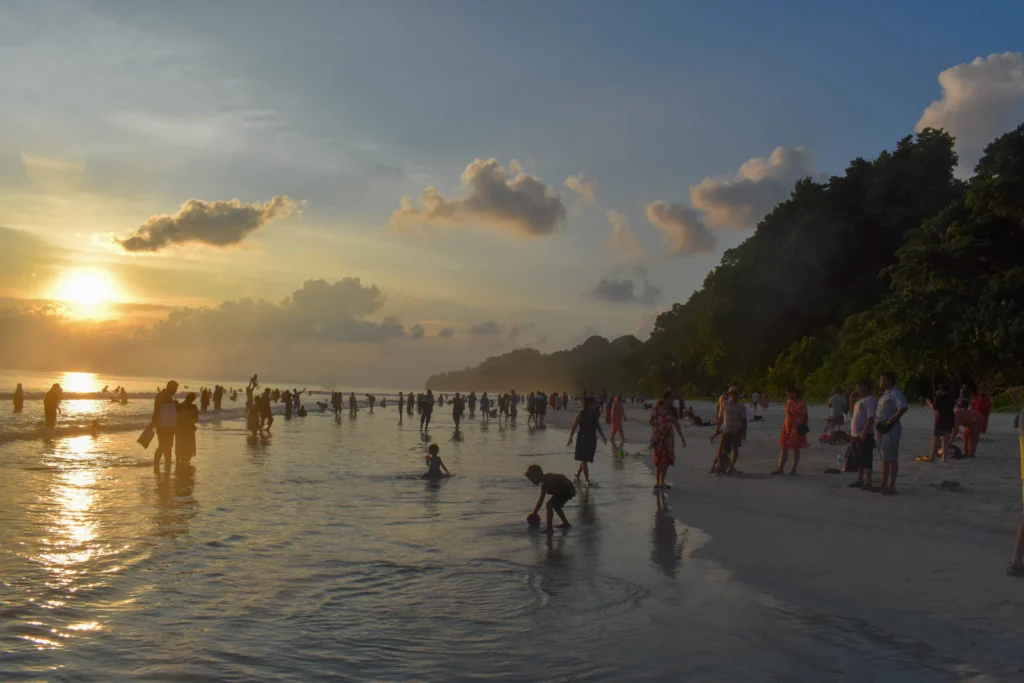
Day 2: Ferry to Havelock (Swaraj Dweep). Morning ferry, check in, lunch, then keep the evening free for sunset at Radhanagar Beach.
Day 3: Elephant Beach snorkelling. A boat to Elephant Beach in the morning while the water is calm, with snorkelling and optional water sports. Afternoon and evening are yours: a nap, a long lunch, or a quiet walk back at your resort.
Day 4: Neil (Shaheed Dweep) and back. A short ferry to Neil for a slower day of beaches and the island’s rock formations at low tide, then an evening ferry back to Sri Vijaya Puram so you sleep near the airport.
Day 5: Fly home. Because you returned the night before, a delayed or cancelled ferry on Day 4 does not cost you your flight.
How many days do you need in Andaman?
- 4 days: Sri Vijaya Puram and Havelock only. Possible, but rushed, and leaves no room if a ferry is cancelled.
- 5 days: Sri Vijaya Puram, two nights on Havelock and a day on Neil. This is the length we plan most often for honeymooners in the dry season.
- 6 to 7 days: Adds a night on Neil, a dive day, or a spare day in Sri Vijaya Puram. We suggest this for families with grandparents, for divers, and for anyone travelling in November, late April or May.
What to pack for each season
December to April (dry season)
- Light cotton and linen clothes, a sun hat and good sunglasses.
- High-SPF sunscreen. The sun is strong all day by March and April.
- A rash guard or full-sleeve swim top for snorkelling, which also saves your back from sunburn.
- Comfortable sandals plus a pair of water shoes for rocky beaches on Neil.
- A refillable water bottle (see the plastic ban below).
May to November (wet and shoulder months)
- Quick-dry clothes and a light rain jacket or compact umbrella.
- A waterproof phone pouch and a dry bag for ferry days.
- Any motion-sickness medicine your doctor recommends, since the sea can be choppy.
- Mosquito repellent, especially for evenings.
All year, carry original photo ID for ferries and hotels, and some cash in case card machines or networks are slow.
Rules and practical details to know before you go
New names for old places
You will see both old and new names on tickets, signs and maps. Port Blair was renamed Sri Vijaya Puram (announced on 13 September 2024). In 2018, Havelock became Swaraj Dweep, Neil became Shaheed Dweep and Ross Island became Netaji Subhas Chandra Bose Island.
Getting there
The only way in for most visitors is by air, into Veer Savarkar International Airport (IXZ) in Sri Vijaya Puram. There are non-stop flights from Delhi, Mumbai, Chennai, Bengaluru, Kolkata, Hyderabad and Bhubaneswar, though schedules change by season, so check current flights before you book.
The plastic ban
Under A&N Administration notifications from September 2019, the islands ban PET bottles under 2 litres, plastic carry bags, small plastic sachets, plastic cutlery and straws. Bring a refillable bottle and a cloth bag.
Permits for foreign visitors
Indian citizens need no permit for the main tourist islands. For foreign nationals, the rules were relaxed in 2026. According to the A&N Tourism notice on the Restricted Area Permit, 29 islands are now excluded from the permit regime and 11 more are exempt for day visits. A Restricted Area Permit (RAP) is still required for nationals of Afghanistan, China and Pakistan, and for tribal reserves and islands not open to tourists. Friends or family joining from abroad should read the notice before booking.
Mistakes we see travellers make
- Booking a cheap monsoon trip for a honeymoon. Lower rates in July rarely make up for cancelled ferries and closed water sports.
- Taking a ferry and a flight on the same day. Always sleep in Sri Vijaya Puram the night before you fly out.
- Booking flights and hotels before ferries. The ferry timetable decides which nights work on each island.
- Trying to see too many islands. Four islands in five days means more time at jetties than on beaches.
- Leaving December bookings until November. For the Christmas to New Year weeks, the best rooms on Havelock and the popular ferry slots go early.
- Scheduling scuba on the last day. Dive early in the trip so there is a safe gap before your flight, and a spare day if the sea is rough.
- Packing plastic water bottles. They are banned. Carry a refillable bottle instead.
- Skipping travel cover. A missed connection or cancelled ferry can cost a night’s hotel and a new flight. The thinking in our guide to choosing travel insurance applies to an island trip too: check what the policy says about delays and missed connections.
Frequently asked questions
Which is the best month to visit Andaman?
February is the single most reliable month, with only about 15 mm of rain on average. January, March and the second half of December are close behind. Late November is the best-value shoulder slot.
Is Andaman good in November?
Yes, for most travellers. It averages about 220 mm of rain over 10 days, mostly as showers, and it dries out as the month goes on. Plan a buffer day for ferries and you will usually be fine.
Can we visit Andaman in the monsoon?
You can, but ferries to Havelock and Neil can be cancelled at short notice and water sports are often suspended. It suits flexible repeat visitors, not honeymooners or first-time visitors.
When does the monsoon start in Andaman?
The India Meteorological Department’s normal onset date for the Andaman and Nicobar Islands is around 20 May, with the south Andaman Sea about 15 May. The actual date varies each year.
Is Andaman too hot in April and May?
Daytime highs average about 32°C to 33°C, only two or three degrees warmer than January. The humidity is what you feel. Plan beach time for early morning and late afternoon, and early May is still workable before the monsoon arrives.
Is 5 days enough for Andaman?
Five days covers Sri Vijaya Puram, two nights on Havelock and a day on Neil at a relaxed pace in the dry season. Choose six or seven days for diving, for travel with older parents, or for shoulder months when you need a spare day.
Which is better for a honeymoon, Havelock or Neil?
Most couples stay on Havelock, which has Radhanagar Beach, Elephant Beach snorkelling and more choice of resorts. Neil is smaller and quieter and works well as a day trip or an extra night at the end.
Do Indians need a permit for Andaman?
No permit is needed for Indian citizens visiting the main tourist islands such as Sri Vijaya Puram, Havelock and Neil. Tribal reserves are off-limits to everyone.
Do foreigners still need a Restricted Area Permit for Andaman?
Most do not for the main tourist islands. The 2026 A&N Tourism notice excludes 29 islands from the permit regime and exempts 11 more for day visits. Nationals of Afghanistan, China and Pakistan, and anyone visiting tribal reserves or unopened islands, still need one.
What is the best time for scuba diving in Andaman?
December to April, as stated on the official Andaman tourism website. The water is calmest and boat trips are most reliable in these months.
If you are deciding between months, or want us to check if your dates work with the ferry timings, send us a message on WhatsApp at +91 79829 78745. Tell us your dates and who is travelling, and we will tell you honestly whether Andaman is the right choice for that week.