
Quick answer
A private India tour gives you your own car, driver and local guides, with the pace set by you rather than a coach. For a first trip, 7 days covers Delhi, Agra and Jaipur comfortably; 11–14 days adds Rajasthan, tigers, Varanasi or Kerala. Go October to March. Five-star private trips start from about US$2,000 per person, land only (indicative).
We plan private, tailor-made India trips for couples and families from the US, UK, Australia and Canada. Each trip below is a starting point: your own car, local guides who know their monuments, and hotels chosen for where they sit as much as how they look.

Why see India privately rather than on a group tour?
India rewards flexibility. Monuments are at their best in the first hour after opening, traffic changes daily, and the moments people remember (chai at a roadside dhaba, a detour to a stepwell) rarely fit a coach timetable. Travelling privately means:
- Your own start times. Be at the Taj Mahal when the gates open, half an hour before sunrise, and back for breakfast before the crowds.
- One car, one driver for the road days. Luggage stays in the car, water is always on board, and you stop when you want to stop.
- Guides only where they add something. A good guide at the Taj, Amber Fort or Mehrangarh is worth it. Nobody needs a guide in a hotel garden.
- No commission shopping stops. You visit the craftspeople you want to see, not the emporium that pays the driver.
- Food your way. Vegetarian, vegan, gluten-free and mild-spice requests are easy when hotels and restaurants are briefed in advance.
Group tours still make sense for some people, usually first-timers on a tight budget. We’ve written an honest comparison of customised itineraries versus group tours if you are weighing the two.
What a day with your own driver and guide looks like
So what does “private” mean on the ground? Here is how we would usually plan a Jaipur sightseeing day in February:
- 8:00 am: Your driver is waiting at the hotel porch. Your guide joins you there or at the first stop.
- 8:30 am: Amber Fort before the tour buses. Up by jeep, then about two hours in the courtyards and the mirror hall.
- 11:00 am: A short photo stop at Jal Mahal on the way back into the city.
- 12:30 pm: Lunch somewhere we trust for clean kitchens, then a rest at the hotel through the warmest hours.
- 3:30 pm: City Palace and Jantar Mantar with the guide, then the old-city bazaars on foot.
- Evening: Free. Dinner at the hotel, a rooftop restaurant, or a cooking session with a local family if you’d like one.
The rhythm is the point: one or two big sights in the morning, a proper break, something lighter in the late afternoon. India is tiring when it’s rushed and very easy to enjoy when it isn’t.

Four sample private India itineraries
Each itinerary starts with the Golden Triangle (Delhi, Agra and Jaipur) because it’s the easiest first trip: short distances, the Taj Mahal, and three very different cities. For a shorter six-day version with a full day-by-day breakdown, see our 6-day Golden Triangle tour.
1. Golden Triangle private tour: 7 days (Delhi, Agra, Jaipur)
Best for: first-time visitors, couples with a week, or a first India stop before the Maldives or Southeast Asia. Best months: October to March. Nights: Delhi 2, Agra 1, Jaipur 3.
- Day 1, Delhi: Met at the airport and driven to your hotel. Rest, then a quiet dinner nearby.
- Day 2, Delhi: Old Delhi early: Jama Masjid, a cycle-rickshaw through Chandni Chowk and the community kitchen at Gurudwara Sis Ganj. Afternoon at Humayun’s Tomb, then a drive past India Gate.
- Day 3, Delhi to Agra: Leave after breakfast on the Yamuna Expressway. Afternoon at Agra Fort, then sunset over the Taj from Mehtab Bagh, the garden across the river.
- Day 4, Agra to Jaipur: Taj Mahal at opening time with your guide, back for breakfast, then drive to Jaipur. Stop at Fatehpur Sikri or the Abhaneri stepwell if you’d like a break on the way.
- Day 5, Jaipur: Amber Fort in the morning, City Palace and Jantar Mantar in the afternoon (the day described above).
- Day 6, Jaipur: A slow day. Block printing in Sanganer or Bagru, a cooking session, Hawa Mahal in early-morning light, or simply the hotel pool.
- Day 7, Jaipur to Delhi: Fly (about an hour) or drive back to Delhi for your flight home.
Hotel ideas, five-star: e.g. Taj Mahal, New Delhi; ITC Mughal, Agra; Taj Jai Mahal Palace or ITC Rajputana, Jaipur.
Hotel ideas, palace and top tier: e.g. The Oberoi, New Delhi or The Imperial; The Oberoi Amarvilas, Agra, with rooms that look towards the Taj; Rambagh Palace or The Oberoi Rajvilas, Jaipur.
Indicative price: from about US$2,000 per person (five-star) or US$4,500 per person (palace and top tier), two sharing, land only. Confirmed in your quote.
2. Golden Triangle and Rajasthan: 13 days (Udaipur and Jodhpur)
Best for: honeymoons, anniversaries and anyone who wants palaces, forts and lakes without rushing. Best months: October to March. Nights: Delhi 2, Agra 1, Jaipur 3, Jodhpur 2, Udaipur 3, Delhi 1.
- Days 1–6, Delhi, Agra and Jaipur: As in itinerary 1.
- Day 7, Jaipur to Jodhpur: A long road day with a good lunch stop on the way.
- Day 8, Jodhpur: Mehrangarh Fort in the morning, a walk through the blue lanes of the old city, Jaswant Thada at golden hour.
- Day 9, Jodhpur to Udaipur: Break the drive at the marble Jain temple at Ranakpur.
- Day 10, Udaipur: City Palace, the old city, and a sunset boat on Lake Pichola.
- Day 11, Udaipur: Free. A cooking class, Saheliyon-ki-Bari garden, or a long lunch by the lake.
- Day 12, Udaipur to Delhi: Short flight back to Delhi, a last night near the airport.
- Day 13: Fly home.
Hotel ideas, five-star: the Golden Triangle hotels above, then e.g. Taj Hari Mahal, Jodhpur, and Taj Fateh Prakash Palace or Trident, Udaipur.
Hotel ideas, palace and top tier: e.g. Umaid Bhawan Palace, Jodhpur; Taj Lake Palace, The Oberoi Udaivilas or The Leela Palace, Udaipur.
Indicative price: from about US$4,000 per person (five-star) or US$9,000 per person (palace and top tier), two sharing, land only, including the Udaipur–Delhi flight. Confirmed in your quote.

3. Golden Triangle, Ranthambore tigers and Varanasi: 11 days
Best for: couples and families who want wildlife and India’s spiritual heart as well as the monuments. Best months: October to March for comfort; Ranthambore’s core zones are open from October to June. Nights: Delhi 2, Agra 1, Ranthambore 2, Jaipur 2, Varanasi 2, Delhi 1.
- Days 1–3, Delhi and Agra: As in itinerary 1.
- Day 4, Agra to Ranthambore: Taj Mahal at opening, then a long drive south-west to the park.
- Day 5, Ranthambore: Morning and afternoon safaris in an open jeep with a naturalist.
- Day 6, Ranthambore to Jaipur: One more morning safari, then a shorter drive to Jaipur.
- Day 7, Jaipur: Amber Fort and the old city.
- Day 8, Jaipur to Varanasi: Fly to Varanasi. In the evening, watch the Ganga aarti ceremony from a private boat.
- Day 9, Varanasi: Dawn boat ride past the ghats, a walk through the old lanes with your guide, and an afternoon at Sarnath, where the Buddha gave his first sermon.
- Day 10, Varanasi to Delhi: Fly back to Delhi for a last night.
- Day 11: Fly home.
Tiger sightings are never guaranteed; three safaris give you a fair chance, and a third night improves it. Safari seats are booked by zone through the Rajasthan Forest Department’s system with each traveller’s passport details, so we book them as soon as you confirm.
Hotel ideas, five-star: e.g. Taj Sawai Madhopur Lodge, Ranthambore; Taj Ganges, Varanasi.
Hotel ideas, palace and top tier: e.g. The Oberoi Vanyavilas or SUJÁN Sher Bagh, Ranthambore; BrijRama Palace on the ghats or Taj Nadesar Palace, Varanasi.
Indicative price: from about US$3,800 per person (five-star) or US$8,500 per person (palace and top tier), two sharing, land only, including safaris and two internal flights. Confirmed in your quote.
4. Golden Triangle and Kerala: 13 days (backwaters and tea hills)
Best for: honeymooners who want monuments first and a slower, greener second week. Best months: November to February, when both north India and Kerala are comfortable. Nights: Delhi 2, Agra 1, Jaipur 2, Fort Kochi 2, Munnar 2, private houseboat 1, Kumarakom or Marari 2.
- Days 1–3, Delhi and Agra: As in itinerary 1.
- Days 4–5, Jaipur: Taj Mahal at opening, drive to Jaipur, then a full day at Amber Fort and the old city.
- Day 6, Jaipur to Kochi: Fly south, usually with one connection. Evening in Fort Kochi.
- Day 7, Fort Kochi: Chinese fishing nets, the old spice warehouses, the Paradesi Synagogue area and a Kathakali performance.
- Day 8, Kochi to Munnar: Drive up into the Western Ghats.
- Day 9, Munnar: A walk through the tea estates with a local guide and a visit to a tea factory.
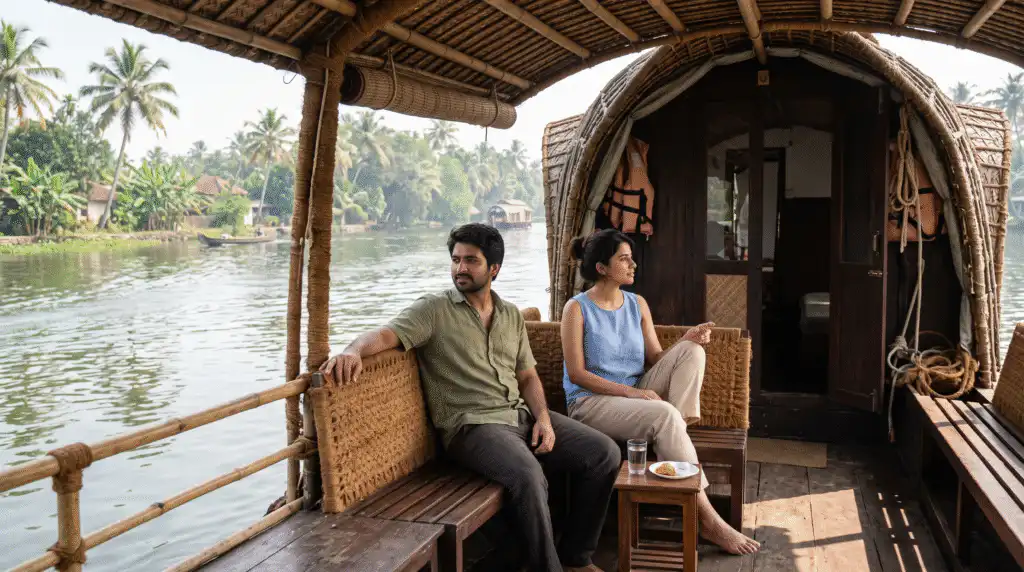
- Day 10, Munnar to Alleppey: Drive down to the backwaters and board your own houseboat around midday. Lunch and dinner are cooked on board.
- Day 11, Alleppey to Kumarakom or Marari: Step off after breakfast and move to a lakeside or beach resort.
- Day 12: Free for Ayurveda, a village cycle ride or the beach.
- Day 13: Drive to Kochi airport and fly home.
A houseboat tip: book a private boat, and one night is enough. Boats cruise in the afternoon and moor for the night, so a second night adds little.
Hotel ideas: the Golden Triangle hotels in your chosen tier, then e.g. Brunton Boatyard or Taj Malabar Resort & Spa, Kochi; Windermere Estate or a tea-estate bungalow, Munnar; Kumarakom Lake Resort or Taj Kumarakom Resort & Spa. Kerala’s best stays are boutique and lakeside rather than palaces.
Indicative price: from about US$3,800 per person (five-star) or US$6,500 per person (palace hotels in the north), two sharing, land only, including internal flights and a private houseboat. Confirmed in your quote.
How much does a private India tour cost?
The biggest factor is the hotel tier. India’s five-star hotels are excellent value; its palace and Oberoi-level hotels can cost three times as much per night. Both are good choices, just different trips.
| Itinerary | Length | Five-star hotels, from (per person) | Palace and top-tier hotels, from (per person) |
|---|---|---|---|
| Golden Triangle | 7 days | about US$2,000 | about US$4,500 |
| Golden Triangle and Rajasthan | 13 days | about US$4,000 | about US$9,000 |
| Golden Triangle, Ranthambore and Varanasi | 11 days | about US$3,800 | about US$8,500 |
| Golden Triangle and Kerala | 13 days | about US$3,800 | about US$6,500 |
Indicative prices, confirmed in your quote. Two people sharing a room, October to March, land only (international flights not included). Christmas, New Year and festival dates cost more; April to June is cheaper but hot in the north.
After hotels, the price moves most with room category (a lake-view or Taj-view room costs far more than the entry room), dates (late December to early January is the dearest), internal flights, and extras such as private dinners and additional safaris.
Real drive times on the classic routes
Most tour pages skip this. These are our planning estimates, door to door, in daylight, with one short stop. City traffic can add an hour.
| Route | Typical time | Notes |
|---|---|---|
| Delhi to Agra | 3.5–4 hours | Mostly on the Yamuna Expressway. The Gatimaan Express train is an alternative. |
| Agra to Jaipur | 4–5 hours | Add 1.5–2 hours for Fatehpur Sikri, or about an hour for the Abhaneri stepwell. |
| Jaipur to Delhi | 5–6 hours | A flight takes about an hour and saves a long last day. |
| Agra to Ranthambore | 5–6 hours | The longest drive on itinerary 3. |
| Ranthambore to Jaipur | 3.5–4 hours | Easy after a morning safari. |
| Jaipur to Jodhpur | 5.5–6 hours | Plan a proper lunch stop. |
| Jodhpur to Udaipur via Ranakpur | 6–7 hours | Includes time at the temple. |
| Kochi to Munnar | About 4 hours | Winding hill roads in the last stretch. |
| Munnar to Alleppey | About 5 hours | Timed to reach the houseboat around midday. |
Prefer the train? The Gatimaan Express leaves Delhi’s Hazrat Nizamuddin station at 8:10 am and reaches Agra Cantt at 9:50 am (timetable checked 26 Oct 2026; we reconfirm running days when booking), and your driver meets you at Agra.
What’s included in a Naviora private trip
- A private, air-conditioned car with an experienced driver for all road days and airport transfers.
- Licensed local guides at the major sights, chosen for their English and their patience.
- Hotels we’ve hand-picked for location and service, with daily breakfast.
- A meet-and-greet when you land in India.
- Internal flights, trains, safaris and houseboats where the itinerary includes them.
- WhatsApp support from our team throughout your trip, from people who know your plan.
Not included unless we agree otherwise: international flights, your India visa, travel insurance, tips, and most lunches and dinners (so you can eat where you like).
Best time to visit India, by region
| Region | Best months | Good to know |
|---|---|---|
| Delhi, Agra, Jaipur | October to March | December and January mornings can be cold and foggy. April to June is very hot. |
| Rajasthan (Jodhpur, Udaipur) | October to March | The monsoon usually reaches Jaipur around 1 July. |
| Ranthambore | October to June | Core zones close for the monsoon, roughly July to September. March to June is hot. |
| Varanasi | October to March | Winter dawns on the river can be misty, which some people love. |
| Kerala | November to February | The south-west monsoon normally reaches Kerala around 1 June. |
Monsoon dates are the India Meteorological Department’s long-term normals; real years vary. Remember the Taj Mahal is closed on Fridays, and Delhi’s air is at its worst in winter, so between November and January we keep Delhi short.
Is India safe for couples and women travellers?
Here is the official picture, as of 26 October 2026:
- The US State Department rates India Level 2, “Exercise increased caution”, and says it advises against women travelling alone in India. It lists Jammu and Kashmir (except eastern Ladakh), the India–Pakistan border, Manipur and parts of central and east India as “Do Not Travel”.
- The UK Foreign Office advises against all travel to Jammu and Kashmir (apart from Jammu city) and within 10 km of the Pakistan border, and against all but essential travel to Manipur. It also warns about harassment of women, drink spiking and road safety at night.
- Australia’s Smartraveller and Canada’s travel advice both say to exercise a high degree of caution, with similar regional warnings.
None of the four itineraries on this page goes near the regions flagged for “do not travel”. In practice, here’s what we do for couples and families:
- Road transfers in daylight, with one driver for the whole road section.
- Guides who meet you at the hotel, and hotels and restaurants we’d send our own families to.
- Shoulders and knees covered at temples, mosques and in old-city lanes. A light scarf helps.
- For couples, holding hands is fine; public kissing still draws stares outside hotels.
We don’t plan Kashmir for overseas visitors, because the US, UK, Australian and Canadian governments all advise against travel there.
Health: water, food and air quality
- Water: drink sealed bottled or properly filtered water only, and skip ice outside good hotels.
- Food: hot, freshly cooked food is safest. Most “Delhi belly” comes from raw salads, cut fruit and buffets that have sat out.
- Air: the UK Foreign Office notes that air pollution is a serious health risk, especially from October to February in north Indian cities. If you have asthma or a heart condition, speak to your doctor before travelling.
- Vaccines: see a travel clinic at least eight weeks before you go, as the UK Foreign Office recommends.
- Insurance: take cover that includes medical treatment and evacuation.
India visas for US, UK, Australian and Canadian travellers
Citizens of all four countries can apply online for an India e-Tourist Visa. Use only the official site, indianvisaonline.gov.in; copycat sites charge far more. Fees from the official table, checked 26 October 2026:
| e-Tourist Visa | USA | UK | Australia | Canada |
|---|---|---|---|---|
| 30 days, arriving April to June | US$10 | US$10 | US$10 | US$10 |
| 30 days, arriving July to March | US$25 | US$25 | US$25 | US$25 |
| 1 year, multiple entry | US$40 | US$40 | US$40 | US$40 |
A 3% bank charge is added to each fee. Five-year e-Tourist Visa fees differ by nationality; check the official fee table. The key rules from the official site:
- Apply at least 4 days before arrival and no more than 120 days ahead.
- Your passport needs at least six months’ validity when you apply, and two blank pages.
- You need a return or onward ticket.
- The 30-day e-Tourist Visa is multiple entry, counted from your first arrival, and can’t be extended.
Since 1 October 2025, international arrivals also complete a free online e-Arrival card within 72 hours before landing, on the same official site or the Indian Visa Su-Swagatam app. We send you a checklist for both before you fly.
Taj Mahal tickets and timings
From the official Taj Mahal site, checked 26 October 2026: foreign visitors pay ₹1,100 for entry, plus ₹200 to go inside the main mausoleum (together about US$14). Children under 15 enter free. The Taj opens 30 minutes before sunrise, closes 30 minutes before sunset, and is closed on Fridays.
What we’d skip, and why
Good planning is as much about what you leave out. We usually steer people away from:
- A same-day trip from Delhi to Agra and back. Seven or more hours in the car and no sunrise at the Taj. One night in Agra fixes both.
- Five cities in eight days. Distances look small on a map. Two or three nights per stop is what feels like a holiday.
- Elephant rides up to Amber Fort. The jeep is quicker, and many travellers prefer not to ride elephants. We plan the jeep by default.
- “Factory visits” that end in a showroom. If you want rugs, gems or textiles, we’ll send you to makers we trust.
- Night drives and overnight trains on a honeymoon. Daylight driving is safer and a good hotel bed beats a sleeper berth.

Who plans your trip
Naviora Journeys was founded by Gaurav Agarwal, an IIM Ahmedabad MBA and former management consultant. We have planned trips to more than 20 countries. We’ve personally visited most of the destinations we sell. Our offices are in Gurugram, near Delhi, and in Bengaluru, so the people answering your WhatsApp messages are in the same time zone as your driver.
We are an official partner of Taj Hotels, and Naviora was named “Rising Star in International Holidays” at the Outlook Business Spotlight Achievers Awards 2025. You can read more about that, and about our feature in Outlook India, on our press page. If this is your first time in the country, our India travel tips for first-time visitors covers dress, money, bargaining and getting around.
Private India tour FAQs
How many days do I need for a first trip to India?
Seven days is comfortable for Delhi, Agra and Jaipur. With 11 to 14 days you can add one more region: Udaipur and Jodhpur, Ranthambore and Varanasi, or Kerala.
How much does a private India tour cost?
As an indication, a 7-day private Golden Triangle trip starts from about US$2,000 per person with five-star hotels, or US$4,500 with palace hotels, two sharing, excluding international flights. Your quote confirms the exact price.
What is the best month to visit India?
October to March for north India and Rajasthan, November to February for Kerala. February and March balance pleasant days with clearer Delhi air. April to June is very hot in the north.
Is India safe for couples and solo women?
The US rates India Level 2, “Exercise increased caution”, and the UK warns about harassment of women. A private driver, daylight transfers, guides who meet you at the hotel and modest dress reduce most of those risks, and our routes avoid every region flagged “do not travel”.
Do US, UK, Australian and Canadian citizens need a visa for India?
Yes. All four can apply online for an e-Tourist Visa at indianvisaonline.gov.in at least 4 days before arrival. The 30-day visa costs US$25 for July to March arrivals and US$10 for April to June, plus a 3% bank charge (checked 26 October 2026).
Can I visit the Taj Mahal on a Friday?
No. The Taj Mahal is closed to general visitors every Friday, so we always plan your Taj visit for another day of the week, and avoid a Thursday night in Agra if you want a sunrise visit.
Will we have the same driver for the whole trip?
In the north, usually yes: one driver and car from Delhi through Agra and Rajasthan. When you fly to Varanasi or Kerala, a local driver meets you there.
Can you plan Kashmir for overseas visitors?
No. The US, UK, Australian and Canadian governments all advise against travel to Jammu and Kashmir, so we don’t plan it for overseas visitors. For a first trip we suggest Rajasthan, Varanasi or Kerala instead.
How far ahead should we book?
For October to March, three to six months ahead is ideal. Palace hotels, Christmas and New Year dates and Ranthambore safari seats are the first to go.
Begin your journey
Plan your private India trip on WhatsApp
Send us your dates, who’s travelling, the hotel tier you have in mind and anything you’d love to see or avoid. We’ll reply with a day-by-day plan and a clear price.